IPG Catalan Bread
Website of the Regulatory Council for the Protected Geographical Indication of Pa de Pagès Català
The etymology of the word pa de pagès already gives us a fairly clear idea of the origins of Catalan Pa de Pagès. But it is necessary to clarify one issue first: historiography did not enter the world of baking (as far as Catalonia is concerned) until well into the second half of the 20th century. So a good part of the statements and assumptions made about the evolution of baking are based on the knowledge we have from other, more documented sectors (such as the world of farming) or because oral tradition has allowed much knowledge of baking, as well as its customs, to be passed down from parents to children for centuries.
The profession of baker was already documented in Classical Greece. That is, in Hellenic cities there were professionals who made a living by making bread and their work was regulated by the authorities. It was logical that this was the case, although many citizens still made bread at home, as was traditional at that time.
In the Middle Ages, the village baker was also in many cases the miller. It was a deep-rooted custom that the farmer who produced cereal would set aside a portion for his private consumption. This cereal intended for making bread had to be ground first, and this is where the baker came into play. The farmer would give his grain to the baker to grind and in return he would give the baker a portion for his work. In this way the bakery obtained a significant part of its flour supply, as long as this private activity did not violate the rules of the nobleman who controlled the territory, who was usually the one who had dominion over the mills.
But what breads were made in the Middle Ages and Early Modern Periods in homes and in established bakeries? In principle, they were the same types of bread. There was practically no difference. Or was there?
Until the second half of the 19th century, the bread made in homes and bakeries was a round, dense, black loaf. This was because the cereals used, mainly wheat and rye, were not ground to the degree of extraction that we have today. That is, they were less crushed grains (more whole grains). This gave the bread the characteristics of a compact, dense, and colored crumb.
The loaves were always round or in elongated shapes but weighing no less than the current 2 kg. The loaf of bread, as we know it now and the small weight of the pieces of bread did not become a custom until the first third of the 20th century.
These round loaves that were made in homes and in the bakeries themselves were not known by a specific name; they were simply breads, although in some cases they could be recognized by their place of origin, but this may have more to do with the professional skill of the bakers or the quality of the flour to which they had access.
It was much later, towards the end of the 19th century, but especially with the arrival of the 20th century, when bakers began to make breads of different formats and weights that they began to "baptize" with other names. This is what we would understand by brand today. Examples of this are specialties such as Vienna Bread, Milk Bread, etc.
But what changed the bread-making system and allowed breads to be made that were different from those that had been made for centuries? Mainly two advances: the appearance of specific yeast for the bakery and the cylinder mill.
In countries such as France and Germany, bakeries had introduced brewer's yeast as a fermenting element in breads, but at the beginning of the 19th century, the first trials were carried out with yeast strains specially designed for bakery ( Saccaromyces cerevisiae ). Brewer's yeast was used to accelerate the fermentation of sourdough (the natural yeast that was used exclusively for centuries); its introduction into the bread-making process gave breads a lighter crumb and better flavor. The use of brewer's yeast spread in Europe between the end of the 18th century and much of the 19th century, until the appearance of pressed or powdered yeast.
The invention of the roller mill, a true innovation in the world of flour mills, was the subsequent trigger for some changes in the bread production process. The roller mill, which appeared at the beginning of the 19th century, allowed the manufacture of much more refined and white flours, like the ones we have today. The roller mill and the plansichter (flat sieves at different levels) revolutionized the world of flour.
These two technological advances in the milling sector allowed for a substantial improvement in the quality of bread (whiter and more digestible); the new flours allowed for finer crusts and crumbly breads. In other words, they allowed for bread to be made into a more delicate product, as we would say today.
With the new flours, both the bread that was made in homes and the bread that was made by the baker changed. They are now as we know them today, because not only has the basic raw material, the flour, changed, but the production process has also changed; the kneading is more intensive and the fermentation times are shortened.
In Catalonia, an important event occurred that also affected the bakery industry: migration. In fact, the Universal Exhibitions of 1888 and 1929 in Barcelona coincided in time with the process of industrialization and urban growth of the Catalan capital and other towns in the country. Thousands of people left their towns in the interior of Catalonia, but people from Aragon, Valencia and Murcia also migrated to Barcelona in the hope of a better life. The works of the Universal Exhibitions and the factories required abundant labor. Among these people who arrived in Barcelona, there were many who were bakers in their towns or had known the world of baking. Many of them found work in the bakeries of the cities; bread is a basic food and the increase in the population of Barcelona required more bread than ever to feed the newcomers.
In parallel with the urban and industrial growth of the city, the bakery was experiencing its own industrial revolution at the end of the 19th century and the beginning of the 20th century. The first machines were being introduced to the sector, such as kneaders and electric ovens. This modernization of the bakery, more industrialized in its methods, despite being considered an artisanal craft, also led to the generalization of a type of bread that had not been common until then: the loaf of bread. Indeed, it was at the beginning of the 20th century that bakers began to abandon round loaves, which required labor for their traditional processes, to embrace the loaf of bread, which weighed less than traditional loaves and allowed for a more industrial and faster preparation.
However, it is easy to understand that urban bakers and those who settled in Barcelona from rural areas combined the production of the new bread with the traditional one. And it is then, when we begin to have written evidence of Pa de Pagès, that we begin to learn about the traditional bread that had been made in the country for centuries.
The methods of making in Barcelona were reproduced in other cities in the country, and the name of Pa de Pagès and the way of making it spread like a wildfire throughout Catalonia. After all, it was the traditional bread that generations of Catalans had known, but now with a generic name: Pa de Pagès. In this way, perhaps not too consciously, bakers and their consumers differentiated the bread that was already common (the barra) with another that was qualitatively better and related to the traditional world that everyone perceived was being lost: the village, village life and everything that this entailed.
All in all, it is easy to convince why Pa de Pagès has maintained its name for more than a century.
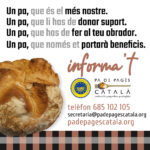
With the IGP Pa de Pagès Català, current consumers are guaranteed that Pa de Pagès will continue to be an artisanal product, made with quality flours and sourdoughs; and formed with the own hands of the country's artisan bakers.
- http://padepagescatala.org/es/